We use cookies to enhance your experience on our website. By continuing to use our website, you are agreeing to our use of cookies. You can change your cookie settings at any time. Find out more

Oxford Education Blog

The latest news and views on education from Oxford University Press.

Menu

Skip to content
  • Home
  • Early Years
  • Primary
  • Secondary
    • English
    • Geography
    • History
    • Maths
    • MFL: Teaching Languages Today
    • Psychology
    • RE
    • Science
  • Children’s
  • Primary
  • International Education
  • About

Search Results for: key stage three

Getting (and keeping) children excited about Key Stage Three science

December 17, 2019March 20, 2020Oxford Science Team 1 Comment

In my opinion Key Stage Three is the most important time in secondary school and the time when we can have the biggest influence on students. It’s a time where we can have a significant impact both academically and socially. I even put this to Twitter and Twitter agreed: 50% of people shared this view! […]


Key Stage 2 Maths: how do I use manipulatives to teach Fractions?

April 27, 2023July 27, 2023Oxford Primary
Children using Numicon

By Matt Ellis, Assistant Headteacher and Maths Lead at Eastfield Primary School. Teaching new areas of maths, especially fractions, can be a printing nightmare in schools, as we teachers often use images to support understanding. But do all these printed visuals actually support and scaffold learning for all children? At our school, we believe that […]

How to revise science at Key Stage 3

January 10, 2023April 4, 2024Oxford Science Team 1 Comment

Revision experts Primrose Kitten and Jessica Walmsley discuss three simple steps to revise Science successfully at Key Stage 3.

How does Echt support the transition to Key Stage 3 and GCSE?

January 11, 2022February 4, 2022Oxford Languages Team

Hands up those who have taught students who have said that they found languages hard, that ‘they couldn’t do languages’ and that they were much better in other subjects? Certainly, during my career as a languages teacher, I have had numerous conversations with young people who felt that their knowledge and understanding of foreign languages […]

Closing the vocabulary gap from a Key Stage 3 perspective

September 22, 2021September 23, 2021Oxford Education

The vocabulary gap is perhaps more difficult to spot at Key Stage 3 than it is in the earlier years. By this stage, students will have 7 years of schooling under their belt, yet, when questioned directly, will struggle to define words they should be very familiar with by now. Exacerbated by Covid interruptions, teachers are faced […]

Using Oxford Smart Activate by Adele Read – Toot Hill School

April 12, 2022April 12, 2022Oxford Science Team
Trialling Oxford Smart Activate

Secondary science teacher Adele Read shares key highlights from trialling Oxford Smart Activate in year 7 curriculum, including many benefits and the key differences compared to her current school curriculum.

KS3 History Q&A with Aaron Wilkes

February 26, 2020March 6, 2020Oxford History Team

The @OxfordEdHistory twitter recently hosted a live twitter Q&A takeover with history teacher and author Aaron Wilkes, answering teachers’ questions and discussing current concerns about teaching KS3 History! Don’t worry if you missed it – you can read all of the KS3 discussions here. Q. I seem to be reading from OFSTED that they are keen […]

11-16 science: making the most of Year 9

February 19, 2024December 4, 2024Oxford Science Team
Oxford Smart Activate

Strictly speaking, Key Stage 3 lasts for three years: spanning Years 7 to 9. But over the last decade, an increasing number of schools have switched to offering a two- or two and a half-year KS3 programme. This has allowed schools to redress the difficulty of covering the lengthy GCSE specification content in only Years […]

Reducing cognitive load in Oxford Smart Activate

February 2, 2024December 4, 2024Oxford Science Team
Oxford Smart Activate

Cognitive load relates to the amount of information that a person can hold in their working memory at any one time. During learning, information is held in your working memory until it has been processed enough to transfer into your larger capacity long-term memory. If new information is not transferred, it will most likely be […]

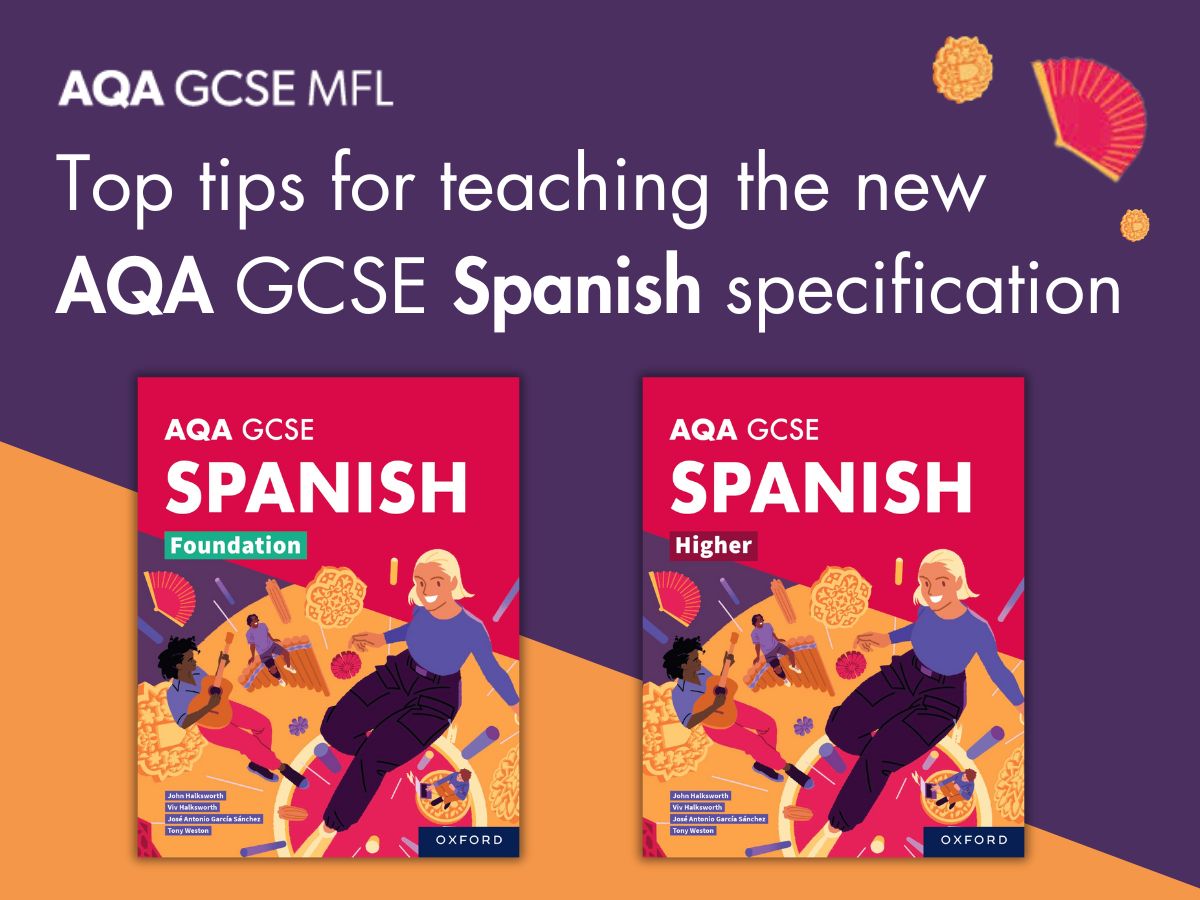
Top tips for teaching the new AQA GCSE Spanish specification

October 30, 2023October 30, 2023Oxford Languages Team
Preparing to teach the new Spanish GCSE AQA specification image

By Tony Weston and José García, authors and Spanish teachers

From September 2024, thousands of budding young Hispanists across the country will once again be embarking on a two-year AQA GCSE Spanish course, one which they hope will bring them both enjoyment and success.

Post navigation

← Older posts

Subjects

A Level animals assessment authors Back to school Ben Crystal book list book recommendations books for girls children's authors children's books children's dictionaries children's fiction closing the word gap COVID-19 CPD curriculum david crystal definitions Dictionaries diversity diversity and inclusion Education empathy english English Literature exam preparation fiction funny books GCSE GCSE science history History teacher home learning inclusive classroom independent reading Key Stage 3 KS3 KS3 Science language literacy lockdown manipulatives Mastery mathematical conversations mathematical language mathematical reasoning mathematics maths maths mastery maths skills mental health metacognition MFL MFL Teachers Modern languages non-fiction numicon Ofsted Ofsted Education Inspection Framework 2019 online learning Oxford Smart Activate Parental engagement Phonics Picture books primary Primary literacy primary maths reading reading development reading for pleasure reading list Read Write Inc. Read Write Inc Phonics remote learning remote learning tips remote teaching revision Sam Holyman school wellbeing science secondary secondary education secondary science shakespeare Shakespeare400 student wellbeing teacher wellbeing teaching teaching ideas teaching methods Teaching Strategies teaching tips transition Vocabulary vocabulary building wellbeing Word Gap words writing

Recent comments

  • Jo on DfE Reading Framework: 7 key take-aways for schools
  • Natalie on 7 ways to support parents and children with SATs

Archives

Useful links

  • Oxford Owl Blog
  • Privacy Policy
  • Legal Notice
  • Cookie Policy

Recent posts

  • How to revise A Level Required Practicals
  • Helping you and your children prepare for the phonics screening check
  • Help your children become confident readers for the Phonics Screening Check
  • 11-16 science: making the most of Year 9

Categories

Top Posts & Pages

  • What is geography, exactly?
  • Drop everything and read (DEAR)
  • Equation building
  • Character Insights: Mr Birling as a construct
  • Number of atoms in the universe
  • How to get your classroom ready for Read Write Inc. Phonics
  • The Alchemist Symbol
  • Building the Maths house: Singapore’s curriculum framework
  • Key Stage 2 Maths: how do I use manipulatives to teach Fractions?
  • What’s next after Read Write Inc. Phonics?
 

Loading Comments...